 Fraunhofer Institute for Machine Tools and Forming Technology
The metal foam center of the Fraunhofer Institute for Machine Tools and Forming Technology IWU is your contact for the development of lightweight concepts and assemblies with metal foam. For that we offer a complete portfolio of products and services based from the idea development over the construction and simulation up to the assembly manufacturing and experimental quality analysis. We would also be pleased to advise you concerning alternative material concepts together with any other information you may require concerning the production material.
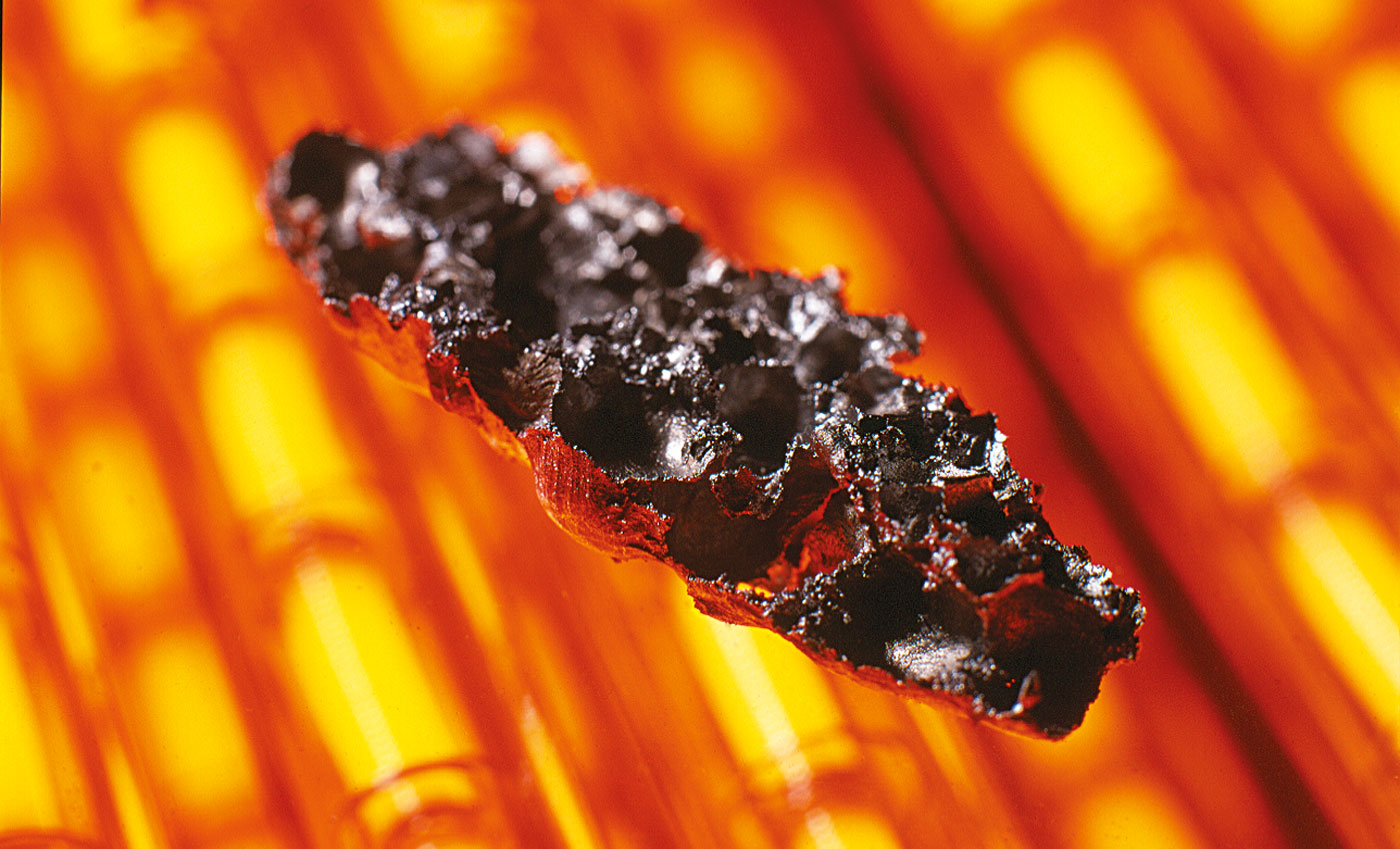
Metal Foam Center
Metal foam – from production to application
What is metal foam?
Metal foam is a high porous and very light material, equally to the model of Mother Nature, exemplified by wood and bones. Metal foams excellently absorb energy as vibration, impact and sound due to their cellular structure. Metal foams are, in general, significantly more stable and temperature resistant than plastic foams. Moreover, they are well suited for shielding electromagnetic waves.
The state of the art are foams based on aluminum and zinc which exhibit a density of less than 0.5 g/cm3, depending on the production method.
Metal foam is usually offered compositely with steel and aluminum sheets realized in sandwiches. Sandwiches feature a much higher bending stiffness than massive sheet metal plates with less overall weight. Due to their properties such as high stiffness and crash behavior, metal foams are highly applicable on many working fields.
At the end of their lifetime, metal foams und foam composites can be recycled without any problems.

Production
The production of metallic foams can be realized by using various processes. This refers to the distinction made between powder-metallurgical processes and metallurgic melting processes.

Powder-metallurgical process chain
Powder-metallurgical process chain
The powder-metallurgical procedure route for foam production involves the mixing of a metal powder (e.g. aluminum) with a gas evolving propellant (e.g. titanium hydride). Further additives mostly serve as foam stabilizer. Subsequently the powder mixture gets compressed and gets foamed in a heat treatment process. The increase of volume for aluminum foams is five times higher than the initial volume – in accordance with that, foam densities of about 0.5 g/cm³ can be reached.

Melting metallurgical process chain
Melting metallurgical melting process chain
When it comes to smelting metallurgy foam production, the foam is produced by blowing into the molten metal. The production of cellular structures can also be realized with the space holder technique.
Fields of application
Sandwiches with aluminium foam core und massive cover sheets are excellently suited for lightweight constructions. The light aluminium foam core functions as a rigid core which holds the top layers at a distance. The top layers are responsible for the applied loads. Semi-finished products are significantly lighter than massive plates as the core material exhibits a low density while maintaining the same load carrying capacity.
This advantage in combination with good energy absorption capability predestines these semi-finished products for machine tool building – an acknowledged application represent machine slides.
Metal foam is also highly suitable as a wall and stiffening element in the building sector – extended with comfort functions such as heat storage and fire protection.
Metal foam can be used as a very good crash absorber in the automotive industry for example, owing to its cellular structure. Only after a high degree of deformation bearing structures of cars and commercial vehicles may be affected.
However, the application of the foam is not limited to this. The foam formation is associated with a high expansion. The material serves like an adhesive as the foam can bridge very big gaps and creates a metallurgical bonding with metals.
| Field of application |
Range of use |
|---|---|
| Automotive industry | Car body knots, longitudinal beams, crash absorber |
| Engineering | Fast moving vibrating devices |
| Building industry | Light floor- and wall elements with integrated comfort function, e.g. heat storage and fire protection |
| Shipbuilding industry | Hatches, doors, ribs, superstructures |
| Railway vehicles | Paving tiles, crash absorbers, complete front modules |
| Design | Partitions, adornments, decoration |
Our range of services
Idea
When it comes to design capabilities and fields of application for metal foams, customers often have the best ideas. But perhaps we can inspire you with new solutions due to our day-to-day activities with this brand new working material.
Design / Simulation
We would be pleased to assist you with the design of your assembly. With the help of the Finite Element Method (FEM) we simulate the component behavior according to your wishes statically, dynamically and thermally so that weaknesses can already be recognized and eliminated in this early stage of development. The calculation of several alternatives and a relative comparison to the original construction is already taken into account. Properties can vary within certain limits and therefore can be adapted to the respective application by the modification of the foam density.
Construction
We design foamed parts and units according to your demands. These include conceptual, component and assembly drawings as well as part lists. The data can be transferred as Pro/ENGINEER®- or AutoCAD®-files. If the customer wants to start with a given design, we can offer you consultation on foam-friendly construction of the components. We are also prepared to give you our outmost support for questions on joining of the foam components together with other semi finished products of the assembly.
Production
For the metal foam production we generally prefer aluminum foam and the powder metallurgical process. For the production several ovens are available in which discontinuous as well as continuous components can be foamed and heat treated. Components can be directly foam filled or foamed. Big assemblies are preferably built up from prefabricated foam semi-finished products such as sandwiches and foam filled profiles. Therefore the semi-finished products are foamed, tailored and generally joint together by welding according to the requirements.
Experimental property analysis
We offer you to test/analyze the produced assemblies individually or based on the installation condition. Therefore statically, dynamically and thermally measurements are possible.
As results we offer you statements on:
- Flexibility
- Deformation components
- Weak point analysis
- Harmonic response functions
- Natural frequencies
- Natural vibration forms
- Damping characteristics
- Operational vibration analysis
- Temperature distribution
- Acoustic performance
Is the aluminum foam not offering the desired effects?
In that case, we advise you with the selection of other materials and offer comparative material studies.
Products
We produce sandwiches, foam filled profiles and complex assemblies upon request and in agreement with our customers. Sandwiches with steel cover sheets can be foamed in a single piece with overall dimensions up to a maximum of 2,00 mm x 1,50 mm. Bigger dimensions can be realized with joining by welding. Foam core heights up to 50 mm can be reached, depending on the overall dimension.
If a heat treatment of the top layer is not possible or undesired, we also produce glued compounds. Compared to directly foamed components a greater evenness can be achieved.
Foam filled profiles can be produced with a length of no more than 6 m. Usually we produce foam out of aluminum alloys. We also offer foams of other base alloys upon request, e.g. zinc and copper.
Standard product program
Steel-Aluminum-Sandwiches
Information
- Steel plate: S235 (St 37)
- Foam: aluminum basis
- Length x width: 1.500 mm x 1.000 mm
- Composite: metallic bond or glued joint
- Fields of application
Applications
- Automotive industry (car body knots, longitudinal beams)
- Engineering (fast moving devices, devices with high damping requirements)
- Building industry (light and bearing floor elements/ columns)
- Shipbuilding industry (hatches, doors)
- Aircraft industry (floor slabs)
Characteristics
Plate dimensions uncut:
1.500 x 1.000 x Sandwich thickness [mm³]

Steel-Aluminum-Sandwich

Calculation results of the centric loaded Steel- Aluminum-Sandwich with boundary conditions
| Sandwichthickness [mm] |
15 | 20 | 25 | 25 | 30 | 30 |
| Steel sheet thickness s [mm] |
2 | 2 | 2 | 3 | 2 | 3 |
| Overallmass [kg] | 58,7 | 63,9 | 69,2 | 90,6 | 74,4 | 95,9 |
| Max. deflection due to own weight [mm] |
0,523 | 0,299 | 0,198 | 0,195 | 0,144 | 0,137 |
| Max. reference stress due to own weight [N/mm²] |
3,99 | 3,02 | 2,48 | 2,42 | 2,14 | 2,03 |
| Max. deflection [mm/1000N] | 1,447 | 0,759 | 0,466 | 0,349 | 0,314 | 0,233 |
| Max. reference stress [(N/mm²)/1.000 N] | 14,7 | 10,2 | 8,0 | 6,4 | 6,7 | 5,4 |
| Lightweight construction factor LCF=1/(mass*deflection) *1000 |
11,8 | 20,6 | 31,1 | 31,6 | 42,8 | 44,8 |
Products for automotive manufacturing

Local stiffening on the D-pillar of the VW-Sharan
Car body knot
- Major improvement concerning stiffness and crash absorbing behavior in the automobile industry possible
- In action in body construction area as knot stiffing
- Up to 10 % higher torsional stiffness of the entire body

Aluminum foam-reinforced B-pillar
B-pillar
- Alternative flangeless “B-pillar”-concept
- Optimized stiffness (closed profile)
- Weight saving of 2,3 kg per vehicle
- Reduction of material input of 50 %
- Functional integration (10 auf 4 composites)
- Prevention of buckling due to metal foam depositor

Rear seat back beam for VW-Golf
Rear seat back beam
- Basic test for weight optimization in the automotive industry
- Metal foam filled profile back rest reinforcement

Hydroformed crash absorber with complete metal foam filling
Crash absorber
- Crash solid for absorption of impact energy for lift and pumping systems
- Safety covers
- Explosion control
Products for mechanical engineering

Crossbeam of a milling machine in the field of large-sized tool and mold making
- Steel – Aluminum foam – Steel – Sandwiches
- Steel 3 mm, Foam 29 mm
- Dimensions: 1 182 x 1 179 x 35 mm³
- Comparison of constructional variants
- Steel design: mass 6,3 t, deflection under own weight
34 µm - Sandwich construction: mass 6,6 t, deflection under own weight 14 µm
- Steel design: mass 6,3 t, deflection under own weight

Z-slide of a HSC-milling machine
- reduction of slide mass up to 28 %
- raising of the dynamical stiffness and of the damping
- first series application of a machine tool assembly in Steel-Aluminum foam-Sandwich-design
Products for the construction industry

Balcony demonstrator
- structure: Aluminum foam plates with rod steel mesh around the edges and mineral surface coating
- advantages for the application of metal foam:
- high bending stiffness together with low weight
- fire retardant effect (DIN 4102)
- effective shielding against electromagnetic waves
- possibility of integrating stainless steel pipes for e.g. water or air supply
- noise protection or -damping (open-cell foam)
- energy absorption and vibration reduction

Temporarily parking block (with project partners)
- section with original dimensions for four parking spaces with appropriate working range
- traversing space: 80 m²
- 4 pillars HEA 600, 2 longitudinal beams HEA 600, 2 beam grillages HEA 180; 2,0 m
- Advantages:
- easy handling in the assembly and disassembly process by existing align elements for position fixing during installation without traffic load
- reduced number of needed bolt connections by usage of these align elements for transverse force and torque transmission
- Coating solutions:
- powder coating
- acrylic resin varnish
- mineral coating of the company Westox
- enamel
Products for shipbuilding

Demonstrator of a ship hull in shell construction
Hull structure of a lightweight inland vessel made of steel-aluminum foam sandwiches (SAS)
The hull of the demonstrator is constructed from steel-aluminum foam sandwiches (SAS) that have been welded together. The use of sandwiches has enabled the design of a rigid hull while maintaining a low weight. The picture shows the demonstrator in its shell construction stage. Sandwiches will be inserted into the four visible openings.
The length of the demonstrator corresponds to a 20-foot unit (approx. 6.25 m). At the upper end of the ship's side, there is a crane runway girder for a ship-mounted handling system for loading and unloading.
The project “Watertruck – Lightweight inland waterway vessel for container transport with ship-mounted handling system for loading and unloading” with the funding code 03SX404B was funded by the Federal Ministry for Economic Affairs and Energy of the Federal Republic of Germany following a decision by the German Bundestag.

Transmission foundation for ship propulsion
- weight reduction 20 %
- approx. 40 m (32 %) laser-welded seam von 125 m
- butt and T-shaped-welding possible at a given evenness
- intensive preparation on the basis of Aluminum foam in the weld zone
- vibration damping behavior

Ship rudder out of curved SAS-sandwiches
Ship rudder
- 22 % lighter
- simple production
Products for rail vehicle construction
Power car cab for a high-speed train
Is it possible to manufacture the power car cab for a high-speed train from aluminum foam sandwiches? In a joint R&D project, this was proven by constructing a power car cab on a scale of 1:1 – the dimensions are 6.8 x 3.0 x 2.8 m3. The high inherent rigidity of the sandwich panels allowed for a substructure-free design, which enabled a weight reduction of around 20 percent compared to conventional metal construction with solid aluminum sheets, while also significantly reducing assembly costs.


Floor element
In 2008, we delivered 21 AFS 2400 x 1100 x 12 panels for use in a Beijing subway. The subway has been in continuous operation ever since.


Product design

Key ring
- available in every diameter

Lamps
- available on request
Selected publications on the topic of metal foam
| Jahr Year | Titel/Autor:in Title/Author | Publikationstyp Publication Type |
|---|---|---|
| 2026 | Aluminiumschaum: Nachhaltige Herstellung und Verwertung Hohlfeld, Jörg; Hannemann, Christian; Berndt, Nadja; Lies, Carsten; Hipke, Thomas |
Zeitschriftenaufsatz Journal Article |
| 2026 | Charakterisierung zur mechanischen und thermischen Belastbarkeit von Aluminiumschaum-Sandwichverbunden für Batteriegehäuse Fritsch, Christian; Schmerler, Rico; Löffler, David; Lies, Carsten |
Konferenzbeitrag Conference Paper |
| 2026 | Development of Sustainable Aluminium Foam Components Infiltrated with Paraffin for Battery Housings Schmerler, Rico; Drossel, Welf-Guntram; Hipke, Thomas; Wertheim, Rafael |
Konferenzbeitrag Conference Paper |
| 2024 | Custom Design to the Application of Open-Cellular Metal Structures Drebenstedt, Claudia; Hannemann, Christian; Hohlfeld, Jörg; Siebeck, Steve; Hipke, Thomas; Kibaroglu, Dilay |
Konferenzbeitrag Conference Paper |
| 2024 | Opportunities of Metal Structures in Cooling Systems Uhlig, Mandy; Grimmenstein, Julius Eik; Langbehn, Pauline; Döring, Ralf |
Konferenzbeitrag Conference Paper |
| 2023 | Innovative Module Design with Actice and Passive Cooling of Traction Batteries Löffler, David; Schmerler, Rico; Grünert, Markus; Clausen, Jan; Schmidt, Simon |
Konferenzbeitrag Conference Paper |
| 2022 | Modularer Wagenkasten für Schienenfahrzeuge - Entwicklung neuartiger Multi-Material-Bauweisen Noteboom, Ulf; Knobloch, Marcus; Vogel, René |
Zeitschriftenaufsatz Journal Article |
| 2020 | Hybridfügen durch Fließlochformen Schmerler, Rico; Grünert, Markus; Rothe, Felix |
Studie Study |
| 2020 | Metal foams with ceramic inserts for security applications Vogel, René; Drebenstedt, Claudia; Szyniszewski, Stefan; Bittner, Florian; Fras, Teresa; Blanc, Ludovic |
Konferenzbeitrag Conference Paper |
| 2020 | Messtechnische Charakterisierung geschlossenzelliger Aluminiumschaumstrukturen Schmerler, Rico; Bräunig, Jan; Hensel, Eric |
Konferenzbeitrag Conference Paper |
| 2020 | The Challenge of Open Cellular Metal Foam Production Hannemann, Christian; Uhlig, Mandy; Hipke, Thomas; Meier, Iris |
Konferenzbeitrag Conference Paper |
| 2019 | Nachbildung des menschlichen Knochens mit Metall - das Testmaterial der Zukunft? Hannemann, Christian; Uhlig, Mandy; Hohlfeld, Jörg; Oefner, Christoph; Schoenfelder, Stephan; Heyde, Christoph-E. |
Konferenzbeitrag Conference Paper |
Diese Liste ist ein Auszug aus der Publikationsplattform Fraunhofer-Publica
This list has been generated from the publication platform Fraunhofer-Publica
Further publications
S. Rybandt, J. Hohlfeld, O. Andersen, H. Göhler, G. Kaufmann, C. Schulze
Multifunktionale Leichtbauelemente aus zellularen Werkstoffen für innovatives Bauen
Bauingenieur 88 (2013) 10, S. 420-434
S. Rybandt, C. Lies, J. Hohlfeld, T. Hipke
Aluminiumschaum – Ein Werkstoff für das Bauwesen?
Teil 2: Anwendungsmöglichkeiten für Aluminiumschaum sowie Aluminiumschaum-Verbunde
Bauingenieur 86 (2011) 10; S. 425-432
S. Rybandt, C. Lies, J. Hohlfeld, T. Hipke
Aluminiumschaum – Ein Werkstoff für das Bauwesen?
Teil I: Herstellung, Eigenschaften, Bearbeitung und Anwendungspotential von Alu-miniumschaum sowie Aluminiumschaum-Verbunden
Bauingenieur 86 (2011) 3; S. 97-105
U. Krupp, A. Ohrndorf, T. Guillen, T. Hipke, J. Hohlfeld, J. Aegerter, A. Danninger, M. Reinfried
Development of a Standard for Compression Testing of Cellular Metals
MetFoam 2007; 5th International Conference on Porous Metals and Metallic Foams; September 5-7, 2007; Montreal, Canada
DEStech Publications, Inc.; Lancaster, USA; p. 407-410
T. Hipke, G. Lange, R. Poss
Taschenbuch für Aluminiumschäume
1. Auflage; Aluminium-Verlag; 2007